
- In short:
- What Are Backlinks and Why Do They Matter for SEO?
- Active vs. Passive Link Building: The Two Core Strategies
- Is Buying Backlinks Allowed According to Google?
- The Underrated Lever: Internal Linking on Your Own Website
- When Can Buying Backlinks Still Make Sense?
- Do Backlinks Really Bring More Traffic? Here's What the Data Says
- How Do You Spot a High-Quality Backlink?
- How to Vet Backlinks Before You Buy: Tools & Traffic Thresholds
- What Types of Backlinks Can You Buy?
- Where Can You Buy Backlinks? Marketplaces, Agencies & Freelancers Compared
- How Many Backlinks Should You Buy?
- Securing ROI: How to Track Whether Your Backlink Investment Pays Off
- How to Buy Backlinks Safely: Step by Step
- Common Mistakes When Buying Backlinks
- Is Buying Backlinks Worth It in 2026?
- Frequently Asked Questions About Buying Backlinks
“Can I just buy backlinks and my site will rank?” We get asked this question at Blogtec almost every week, usually with a skeptical undertone, because the internet has just as many warnings as it has sales pitches. Both are true to some extent.
One half of the internet tells you that bought links will tank your rankings overnight. The other half sells you link packages with promises of guaranteed top positions. Both are oversimplified.
So we’re answering this question here as honestly as we can: with data, with Google’s guidelines in plain language, and with what we’ve learned from 8 years of link building for hundreds of clients across the widest range of industries.
This guide is deliberately thorough, because “buy backlinks” isn’t a yes/no question you can answer in three sentences. Too many factors decide whether a bought link helps your website or ends up hurting it.
In short:
- Buying backlinks technically violates Google’s spam policies. Most SEO-savvy companies buy links strategically anyway.
- What matters isn’t whether you buy links, but how: topically relevant, editorially placed, from sites with real traffic.
- A strong backlink profile demonstrably correlates with better rankings, but only once technical SEO, structure, and content are already solid.
- Buy sloppily (link farms, mass-produced links, exact-match anchors) and you risk a penalty. Buy strategically and you build authority that would take far too long to earn organically.
What Are Backlinks and Why Do They Matter for SEO?
A backlink is simply a link from someone else’s website to yours. Sounds basic, but it’s been one of the core principles behind Google’s PageRank algorithm for over 20 years.
The underlying idea is simple and intuitive: when a page links to you, that’s essentially a recommendation. The more topically relevant, authoritative pages link to you, the more trust “passes” to your domain, and the more likely Google is to consider your content trustworthy and relevant enough to show near the top of search results.
Even though Google has expanded its algorithm with hundreds of additional signals over the years, backlinks remain one of the strongest off-page ranking factors today, alongside countless on-page signals like content quality, technical performance, and user experience.
What matters here isn’t the sheer number of links, but above all their quality, topical relevance, and placement. A single link from a highly regarded trade publication can be worth more than a hundred links from random, topically irrelevant directories.
Broadly speaking, we distinguish two categories: organically grown backlinks, which appear because someone voluntarily links to your content, and actively built backlinks, where you yourself, whether through outreach, partnerships, or buying links, actively secure the placement.
Both approaches have their place, and in practice, the most successful websites usually combine both.
Active vs. Passive Link Building: The Two Core Strategies
Before we get into buying links in detail, it’s worth looking at the two fundamental strategies behind how backlinks come about in the first place. This helps you see where buying backlinks actually fits in, and why it’s the most practical route for many websites.
With passive link building, links appear entirely on their own, because other website owners voluntarily consider your content valuable enough to link to. This usually requires a steady stream of high-quality, original content, things like comprehensive guides, original studies, or tools that others genuinely want to cite.
The big advantage: these links tend to look especially trustworthy to Google, because nobody paid for them or actively asked for them. The downside: you have virtually no control over speed, volume, or quality. For young websites without much reach, it can take years to accumulate a meaningful number of passive links.
With active link building, you take matters into your own hands: you reach out to website owners directly, write guest posts, form partnerships, or buy backlinks directly through a marketplace or agency.
The advantage is obvious: you have far more control over anchor text, placement, timing, and the choice of link sources, and you typically see visible results much faster.
The trade-off: active link building requires either a lot of time (manual outreach) or budget (buying links), and if done poorly, it can look unnatural.
Organic Link Building vs. Buying Backlinks: A Direct Comparison
| Criterion | Active Link Building | Passive Link Building |
|---|---|---|
| Initiative | You proactively reach out or buy strategically | Links appear on their own, with no effort on your part |
| Control | High control over source, anchor text, and timing | Little control, dependent on chance |
| Speed | Fast, plannable | Slow, often takes years |
| Effort | Time- or budget-intensive | Requires consistently high-quality content |
| Risk | Sloppy execution: risk of a penalty | Low, since it grew organically |
| Scalability | Easily scalable through budget | Hard to scale |
Most successful SEO strategies rely on a combination: high-quality content that passively attracts links, paired with active, strategic link building that deliberately speeds up this naturally slow process. Buying backlinks (the main topic of this article) is one form of active link building.
You don’t have to choose one strategy over the other.
The two approaches aren’t mutually exclusive, they complement each other: while your content team works on guides and studies that attract passive links long-term, you can build visibility right now through active, bought link building, instead of waiting months or years for the first organic links to appear.
Is Buying Backlinks Allowed According to Google?
The honest answer: no, not in the strict sense.
Google’s spam policies officially classify the targeted buying or selling of links intended to influence rankings as “link spam.” Anyone who passes off paid links without markup like rel=”sponsored” or rel=”nofollow” as an editorial recommendation formally violates Google’s guidelines on marking outbound links.
Sounds strict, and formally, it is. But a quick look back helps put the risk in perspective: before the so-called Penguin update in 2012, sheer link volume was enough to manipulate rankings fairly reliably.
Anyone who bought enough backlinks climbed the rankings almost guaranteed. Google has since massively evolved its algorithms specifically to detect these kinds of unnatural link patterns. Here’s what that means in practice today:
- Recognizable patterns are the real risk, not buying links itself.
Google mainly detects sudden, unnatural spikes in backlinks, link networks (PBNs) where sites link to each other in a closed loop, and masses of exact-match money-keyword anchor texts like “cheap backlinks for sale” instead of natural phrasing. - Consequences range from silent devaluation to a manual penalty.
In the most harmless case, the algorithm simply ignores the link, it just delivers no SEO effect. In the worst case, a manual penalty hits the entire domain, causing rankings to collapse across every keyword. - There’s a “clean” middle ground that works.
Paid posts with correct rel=”sponsored” markup are fully compliant. They just don’t officially count as a direct ranking signal anymore, they work only through traffic, brand awareness, and indirect visibility.
An important historical turning point for understanding this risk, one many website owners don’t even know about:
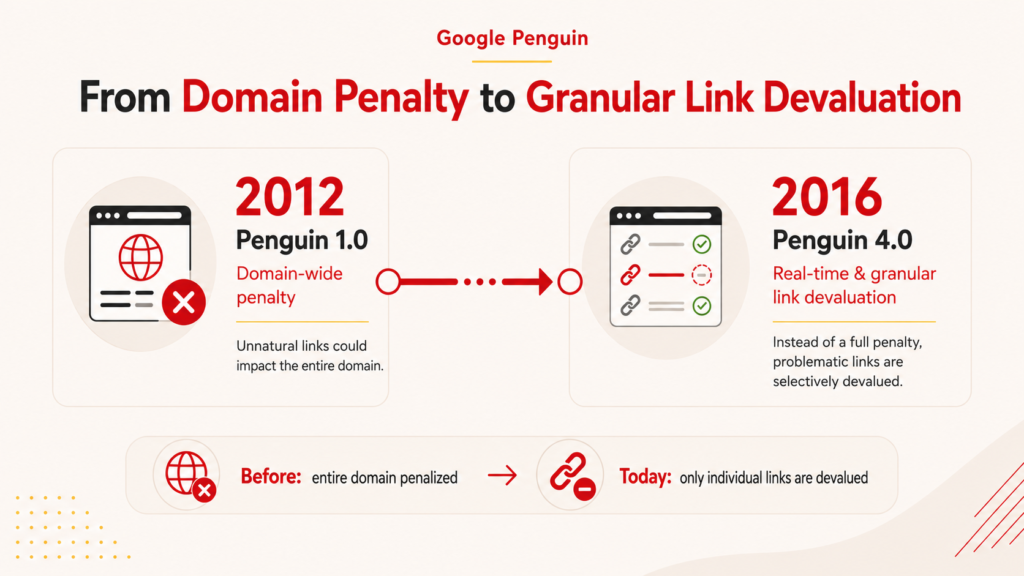
Until 2016, Penguin ran as a periodic update that would severely penalize entire domains suspected of link spam, sometimes for months, until the next update rolled out. With Penguin 4.0 in September 2016, Google fundamentally changed this: Penguin has run in real time as a core part of the algorithm ever since, and works far more granularly.
Instead of penalizing the entire domain, Google now primarily devalues individual suspicious links. The affected page simply loses the ranking signal from those links, without that necessarily dragging the rest of the site down with it.
In practice, that means: the worst-case scenario of a full manual penalty has become rarer since 2016, but the underlying risk of low-quality links hasn’t disappeared. Bad links often simply stop bringing you any value, instead of putting your entire domain at risk.
That lowers the catastrophic risk, but it’s not a free pass: anyone who systematically builds recognizable spam patterns still risks a manual penalty.
Despite this clear stance, an enormous number of companies buy links strategically in practice, including many sitting at the top of the search results.
The difference between “it works” and “it gets penalized” almost always comes down to the quality and naturalness of the execution, not simply whether money changed hands at all.
That’s exactly why choosing the right provider and link source matters so much. You’ll find a concrete checklist for that further below.
The Underrated Lever: Internal Linking on Your Own Website
Before we get to when bought links are worth it, an honest detour: the most effective backlink lever often costs you no money at all. It’s already sitting on your own website.
Internal linking, meaning links between your own pages, distributes the “link equity” your domain holds overall, directing it specifically to the pages you want to rank.
Google itself explicitly recommends in its guidelines on links that every important page should receive at least one internal link from another page on your site, and that anchor text should be descriptive rather than generic, internally too.
Ahrefs also ranks internal linking as one of the most underrated levers in SEO, because it’s entirely within your own control.
In practice, that means: link from your strongest pages (usually the homepage or high-ranking blog posts) with descriptive anchor text to the pages you actually want to push, like your money pages.
Also watch out for so-called “orphan pages“: pages that no other page on your site links to. Google struggles to even find and categorize these pages. They can barely rank at all, no matter how many external backlinks you build otherwise. If you’re not sure how solid your current internal link structure is, an SEO & GEO Audit uncovers exactly these blind spots.
Here’s the point many people miss when buying links: internal linking also amplifies the effect of every backlink you buy. An external link that points to a page well-integrated into your site structure spreads its impact via internal links to other pages on your domain. If that same link instead points to an isolated page with no further internal links, most of its value evaporates.
Before you invest in external links, it’s worth doing a quick, free check of your own internal link structure. Often, you’ll see a noticeable ranking effect from this alone, without a single bought link.
When Can Buying Backlinks Still Make Sense?
Buying backlinks isn’t a free pass, but in certain situations, it’s a sensible and economically sound shortcut:
- Your domain is still young or unknown.
Without existing authority, organic link growth often takes years. Even with excellent content, a new site rarely gets links from established publishers overnight. Targeted link building can significantly speed up this process. - You want to defend or strengthen a top ranking position.
Ranking positions are rarely permanently stable, especially when competitors are actively building backlinks themselves. Ongoing link building defends existing top positions and creates a buffer against catching-up competitors. Additional backlinks also rank among the most effective levers for jumping from positions 4 to 10 into the top 3, according to studies (more on that below). - You want more mentions in AI-generated answers
Backlinks increasingly influence your visibility in ChatGPT, Perplexity, and Google AI Overviews too, not just classic Google rankings. AI systems mention domains with a higher Authority Score noticeably more often in their generated answers (more on that below in the GEO section). - Buying links is part of a bigger strategy, not the only tactic.
Link building works best combined with solid content and technical cleanliness, not as an isolated tactic on its own. More on that in the next section.
The Sandbox Effect for New Domains
One thing to note for brand-new domains: many SEOs report a kind of “sandbox” effect, where freshly launched websites don’t see a noticeable ranking increase for a few months, even with solid optimization. Google itself has never officially confirmed an explicit sandbox filter.
Google Search Advocate John Mueller explained that there’s no classic sandbox mechanism, but rather a lack of trust signals and data about a young domain, which Google only builds up over time.
In practice, that means: don’t expect bought backlinks to show their full effect immediately on a brand-new domain. The missing domain history often overlaps with the usual settling-in period new links need anyway.
Patience and consistent link building, rather than one-off campaigns, matter especially here.
A typical example from practice: a young B2B company with good, technically clean content, but no network or PR history, has little realistic chance of earning relevant backlinks organically within a reasonable timeframe.
This is exactly where targeted, high-quality link building can make the decisive difference in becoming visible at all.
Do Backlinks Really Bring More Traffic? Here’s What the Data Says
Enough theory: what do the numbers actually show? We looked at the most relevant independent studies on the topic instead of relying on gut feeling:
- Ahrefs analyzed roughly a billion web pages: the more referring domains a page has, the higher it ranks on average, and pages with zero referring domains overwhelmingly get no organic traffic at all. The correlation holds up across nearly every industry and niche studied.
- Backlinko analyzed 11.8 million Google search results and found the strongest measured correlation of any ranking factor studied: the number of referring domains correlates more clearly with top positions than any other signal examined. Pages ranking in positions 1 to 3 have, on average, 3.8 times as many referring domains as pages in positions 4 to 10.
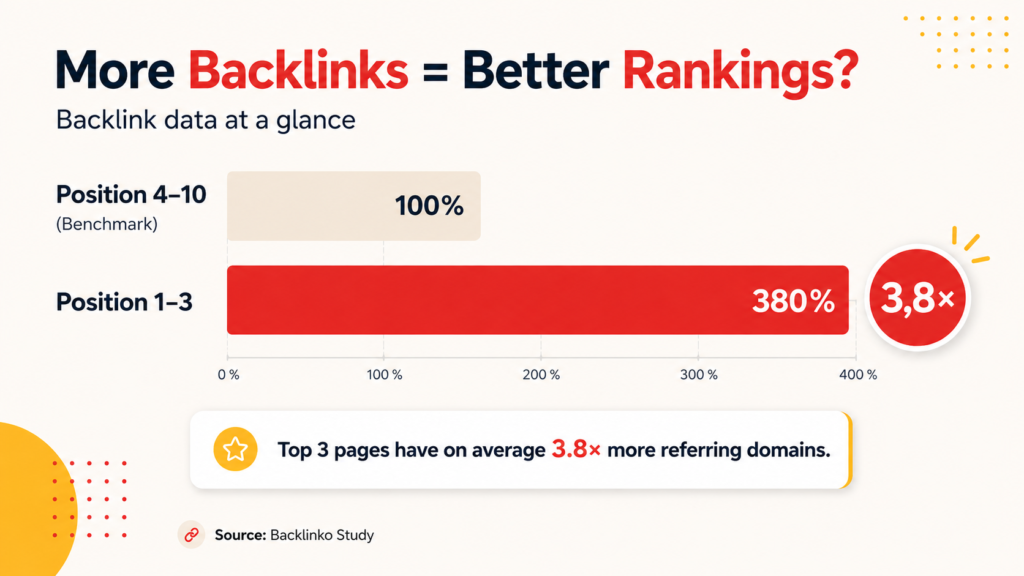
Put these numbers in perspective correctly: correlation isn’t proof of causation. But the consistency of this relationship across multiple independent, large-scale studies makes backlinks one of the most reliable ranking signals we know of.
Just as important, though, is the prerequisite for it to work: backlinks act as an amplifier, not a replacement. Without clean technical SEO (crawlability, indexing, load time, mobile usability), a clear site structure, and high-quality, relevant content, even the strongest backlink profile largely falls flat.
Google can only rank a page it can technically crawl cleanly and classify as relevant in the first place. Link building is therefore always the second step in an SEO strategy, never the first.
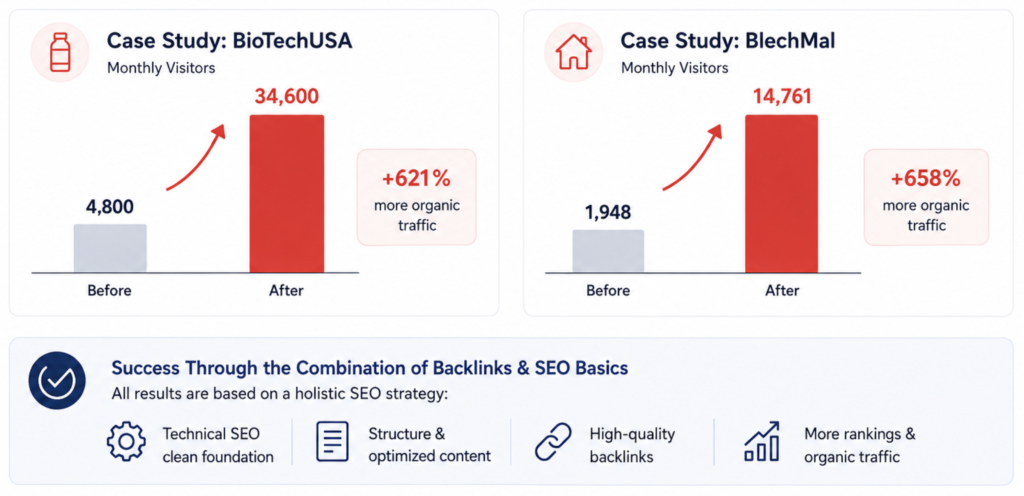
We see the combination of solid basics and strategic link building actually working on a regular basis with our own clients: at BioTechUSA, organic traffic grew from 4,821 to 34,604 monthly visitors, at BlechMal from 1,948 to 14,761, in both cases through a combination of solid content and consistent, topically relevant link building.
Are Backlinks Becoming Relevant for GEO and AI Search Results Too?
This question is becoming more important with the rise of ChatGPT, Perplexity, and Google AI Overviews: do backlinks still count for anything there?
Semrush studied this together with SEO expert Kevin Indig, analyzing 1,000 domains across five AI platforms (ChatGPT, ChatGPT with search, Gemini, Google AI Overviews, and Perplexity).
The key findings:
- Quality beats quantity. AI systems mention domains with a higher Authority Score noticeably more often in their generated answers. The effect only kicks in above a certain authority threshold though, it isn’t linear from the start.
- Nofollow links count for AI systems almost as much as dofollow links. The measured correlation with AI visibility was nearly identical for both link types. That result turns classic SEO logic somewhat on its head.
- Image-based links perform at least as well as text links, sometimes even better. Perplexity and ChatGPT Search in particular weight backlinks from graphics and charts heavily.
In practice, that means: a pure focus on classic dofollow link building is no longer enough to stay visible in AI search results too.
Nofollow mentions from authoritative sources (like press portals or forums) retain their value, and your own well-designed graphics and data visualizations become an additional strategic lever for visibility.
How Do You Spot a High-Quality Backlink?
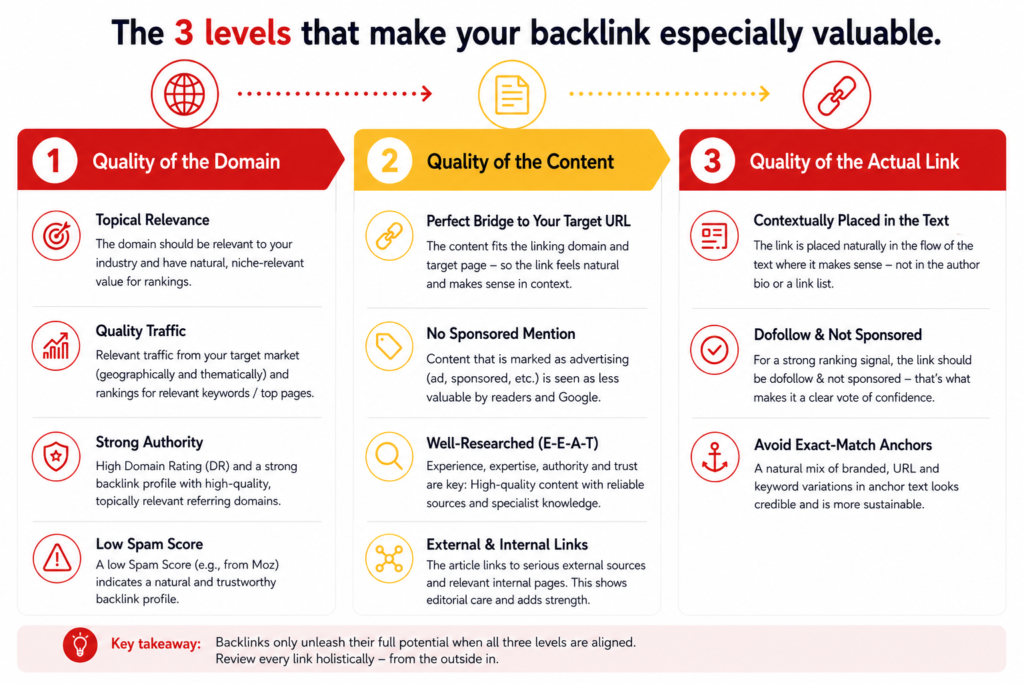
Not every backlink is worth the same. Before you buy, it’s worth looking at three levels: domain quality, content quality, and the quality of the link placement itself.
Only when all three check out does the link actually do anything for you. You can use the list below directly as a checklist for evaluating your backlinks.
Level 1: Domain Quality
- Topical relevance
The domain should be a content match for your industry. A link from an unrelated site looks unnatural and brings little ranking value, even with a high Domain Rating. - Real quality traffic
Don’t just check whether traffic exists at all, check whether it fits you: does it come from your target market (relevant traffic location or country), and does the site rank for keywords or top pages that are topically relevant to your business? - Strong authority
Look at Domain Rating (DR), but also the ratio of referring domains to DR. A high DR with suspiciously few referring domains can be a warning sign. It’s also worth checking the site’s own strongest backlinks: are they topically relevant, or does the profile look artificially assembled? - Low spam score
Tools like Moz show a spam score that flags suspicious patterns in a domain’s backlink profile. A noticeably high value is a warning sign regardless of otherwise good metrics.
Level 2: Content Quality
- A genuine bridge between the domain and your target URL
The content should fit both the linking domain and your target page topically. Only then does the link feel natural in context instead of forced. - No “Ad” label
If a piece is openly marked as paid advertising, readers and sometimes Google too rate it differently from editorial content. What matters for you: transparent labeling where required, but no clumsy “Ad” tag slapped over an otherwise genuinely informative article. - Well-researched (E-E-A-T)
Google increasingly evaluates content based on Experience, Expertise, Authoritativeness, and Trust. A superficial piece with no identifiable sources or subject expertise also devalues the link it contains. - External and internal links within the piece
An article that itself links cleanly to trustworthy external sources and relevant internal pages feels editorially maintained instead of a pure link dump.
Level 3: Quality of the Link Placement Itself
- Organically placed in the text
The link should sit within the body text, wherever it makes contextual sense. It doesn’t belong at the end of the article or in a link list. - Dofollow and not sponsored
For a classic ranking signal, dofollow without sponsored markup matters most (see the guest posts section further below too). If that matters to you, clarify the exact attribution before you buy. - Avoid exact-match anchors
If a link uses your exact money keyword as anchor text, that’s one of the most easily detectable spam signals. A natural mix of branded, URL, and keyword variations looks far more credible.
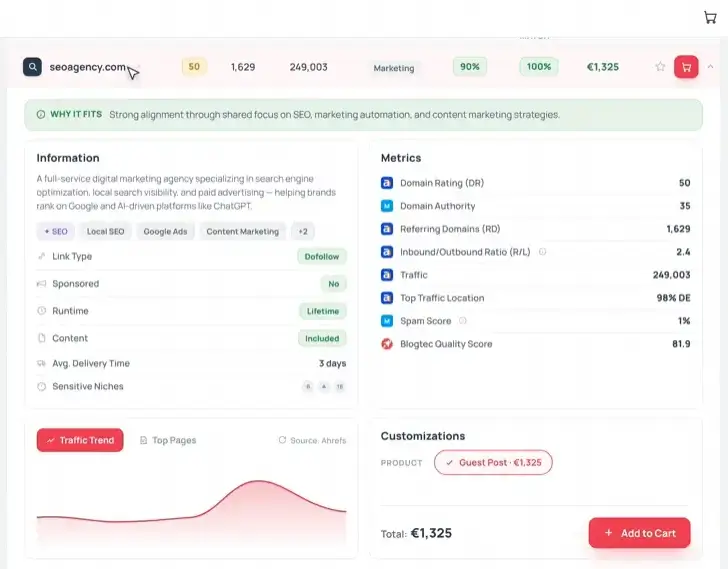
In the Link Center, you can see key metrics like Domain Rating, traffic, and niche transparently before you buy. For the content quality of the piece and its placement, it’s also worth checking the article draft, which you can approve before publication.
How to Vet Backlinks Before You Buy: Tools & Traffic Thresholds
The checklist above shows you what matters. But how do you check that in practice before you pay? A handful of SEO tools have become the standard for evaluating backlinks:
- Ahrefs: the most comprehensive tool for backlink analysis. Shows Domain Rating, referring domains, traffic estimates, and a site’s complete link history, including retroactively. That helps spot dangerous past visibility drops.
- Sistrix: particularly strong for tracking a domain’s visibility over time. A stable or rising Visibility Index is a good sign that the owner actively maintains the site and hasn’t been penalized.
- Majestic: offers Trust Flow and Citation Flow, two complementary trust metrics that work independently of Domain Rating and help expose artificially inflated link profiles.
- Moz: Domain Authority (DA) is one of the best-known authority metrics on the market and works well for quickly comparing multiple link sources. Spam Score rounds out the picture by flagging suspicious patterns in a backlink profile before you buy.
- Semrush: covers backlink data as well as Authority Score, which, per the study cited above, is particularly relevant for visibility in AI search results.
Beyond the raw metrics, it’s worth looking at the actual organic traffic of the linking site. Domain Rating alone tells you nothing about whether anyone actually visits the site.
As a rough rule of thumb: sites with only a few dozen visitors a month bring little SEO value even at a high DR, because they lack the visibility to pass on to you in the first place. Depending on your niche and market size, anywhere between a few hundred and several thousand monthly visitors is a realistic minimum bar.
For very small, highly specialized niche sites, less can still be enough if topical relevance is correspondingly high. In the Link Center, you can see this traffic data directly next to every listing, with no tool research required on your end.
What Types of Backlinks Can You Buy?
Not every link type suits every goal. Here’s an overview of the most common formats.
Guest Posts & Link Insertions
The guest post is probably the product most people have in mind when they search for “buy backlinks.”
The name is a bit misleading: you don’t have to appear as the author yourself or publish under your own name. “Guest post” has simply become the umbrella term the industry uses for this link-building tactic.
There are really two variants behind it: for a classic guest post, we write a brand-new article for a third-party website and embed your link editorially within it. With a link insertion, we instead add your link into an existing, often already well-ranking article.
That often works faster, because the page has already built up trust and rankings.
In the Blogtec Link Center you can filter from more than 10,000 websites by niche, language, and quality tier. Our Link Finder AI finds the best match for you in seconds. Prices start at €100, with a best-price guarantee.
Guest posts and link insertions don’t come in “one flavor.” The combination of link attribute and markup has a direct impact on SEO effect and policy compliance:
- Dofollow, no sponsored markup. This is the most common and most valuable variant on the market. The link counts as a full ranking signal, but should still feel editorial rather than crudely placed.
- Dofollow with rel=”sponsored”. This is fully compliant with Google’s guidelines. The link officially doesn’t count as a direct ranking signal, but still works through traffic, brand awareness, and visibility.
- Nofollow (with or without a sponsored tag). This isn’t a direct ranking signal for classic Google SEO, but according to recent studies, it’s nearly as valuable as dofollow for AI search systems (more on that further below in the GEO section).
Most backlinks in the form of guest posts and link placements are dofollow links without sponsored markup. In our backlink marketplace, you can see the exact attribution transparently before every purchase, so you can filter specifically for your strategy.
Brand Mentions
With a brand mention, your brand name shows up in the content of a third-party website, which can happen entirely without a classic, clickable backlink. That sounds like it’s worth less than a classic link at first, but it’s exactly what makes this category so interesting right now: AI search systems like ChatGPT, Perplexity, and Google AI Overviews increasingly treat brand mentions as an independent trust and relevance signal, regardless of whether a dofollow link is attached (more on that in the GEO section further below).
Brand mentions are a relatively young product category, one that only really gained importance with the rise of GEO.
Right now, plenty of backlink marketplaces are building out their own dedicated brand mention offerings and positioning themselves early in this space. For the coming years, we expect this category to keep gaining relevance alongside the growing share of AI-driven search behavior.
You’ll also find brand mentions in the Link Center, priced individually depending on the publication.
Business Directories
A listing in a vetted industry or business directory is usually a simple, structured link next to your business name, address, and short description, often a mix of dofollow and nofollow links.
A single listing rarely brings much direct ranking power on its own. What it does do is strengthen your local SEO and your visibility in AI chatbots (GEO), through the combination of many consistent citations (name, address, phone number).
Don’t expect a noticeable ranking jump from a single listing, think of it instead as a solid building block for your trust profile.
Our Business Directory package includes 20 manually created links at an average DR of 50, starting at €279.
Press Releases
A press release lands on multiple press portals simultaneously, usually with nofollow links, which is why the direct ranking effect of any single link stays limited.
The real value lies elsewhere: you build a large number of simultaneous brand mentions and citations in a short time, which is ideal for trust building and visibility in AI search results.
This format works best for concrete occasions like product launches, funding rounds, or company milestones, and less well for deliberately building rankings for individual money keywords.
Our press releases include writing and publishing on 20 press sites, starting at €199.
Forum Links / Community Links
Forum links sit within real discussions on niche and community platforms, usually as a dofollow link with modest individual authority.
Their value lies less in the individual link and more in diversification: a natural backlink profile also needs affordable, topically relevant link sources alongside expensive editorial links, otherwise it quickly looks artificially assembled.
Use forum links as supporting tier-2 links that reinforce your existing, stronger backlinks, rather than as your main ranking driver. Starting at €99 for 4 links, with a 6-month guarantee.
Advertorials
An advertorial is a complete editorial article that naturally incorporates your brand, usually on an authoritative, high-traffic publication.
Unlike a classic guest post, the link here typically carries nofollow and sponsored attributes, so the direct SEO impact on your rankings usually stays low.
The real benefit lies in digital PR and GEO: the high-quality editorial placement and brand mention on a respected publication builds trust, brand awareness, and visibility in AI search results, even without a classic ranking signal.
You’ll also find a dedicated section for advertorials in our backlink marketplace, priced individually depending on the publication.
More Backlink Categories: Social Media & Networking
For the sake of completeness: not every backlink category is something you can buy, and we wouldn’t recommend trying to anyway. There are two categories you should build up yourself, alongside your bought link building:
Social media backlinks
… appear when you share content on platforms like LinkedIn, Instagram, or Pinterest and others link to it, comment on it, or spread it further. Most of these links are nofollow and therefore don’t count directly as a classic ranking signal.
According to the Semrush study cited earlier, though, they contribute measurably to visibility in AI search results, and they generate genuine referral traffic and brand signals that Google treats as evidence of your company’s legitimacy.
Networking backlinks
… come from building real relationships with other website owners, industry experts, or partners, for example through mutual mentions, joint webinars, or shared case studies.
You can’t “buy” these links by nature, but you can actively cultivate them: through active communication, offering value to the other side, and patience. Combined with bought guest posts and directory listings, this creates a far more natural and widely distributed backlink profile than pure link buying could ever achieve on its own.
Where Can You Buy Backlinks? Marketplaces, Agencies & Freelancers Compared
If you’ve decided to buy backlinks, you generally have three sources to choose from, each with very different levels of quality, transparency, and support:
- Backlink marketplaces:
Online platforms where publishers and buyers connect directly. You usually see metrics like Domain Rating and traffic transparently before buying and can filter specifically. Quality varies a lot here, though, between curated platforms and pure mass-production providers. - Traditional SEO agencies:
Full-service providers who handle research, outreach, and placement entirely for you. You get personal advice and strategy, but usually pay a premium over the pure marketplace price. - Freelancer platforms:
Individual service providers who broker backlinks or run their own content sites. Can be affordable, but requires especially careful vetting, since quality and reliability vary widely.
Blogtec deliberately combines the advantages of the first two worlds: through our backlink marketplace, you buy individual links directly and transparently, just like on a marketplace, with full metrics before you buy. If you’d rather outsource the entire process, our monthly backlink packages take on the role of a full-service agency, including planning, research, and reporting.
The Best Backlink Marketplaces at a Glance
If you want to research independently which marketplaces are currently performing best: we scored the most relevant providers on transparency, pricing, selection, usability, link-finder quality, additional services, and support (0 to 10 points per criterion, 70 points maximum overall).
| Marketplace | Score | Particularly Strong At |
|---|---|---|
| Blogtec ⭐ | 65/70 | Curated portfolio, AI link finder, full-service option |
| Backlinked | 57/70 | Transparent metrics, large international selection |
| Linkbroker | 57/70 | Consultative approach, clear split between SEO and GEO links |
| Bazoom | 54/70 | International reach, many link types |
| Whitepress | 50/70 | Very large selection, many languages |
| FATJOE | 45/70 | White-label service rather than an open marketplace |
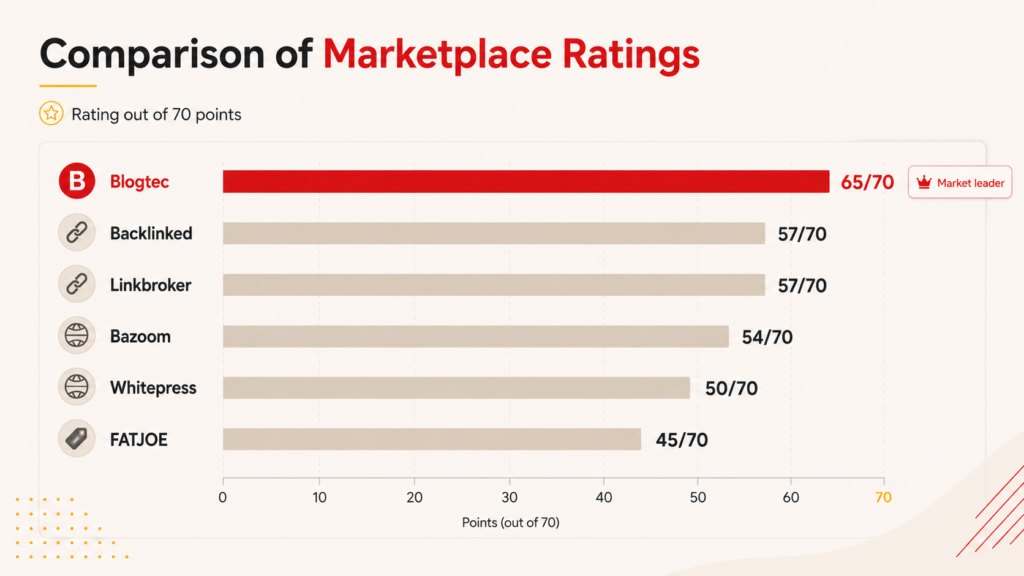
You’ll find the detailed breakdown with all scoring criteria in our comparison article The 6 Best Backlink Marketplaces.
How Many Backlinks Should You Buy?
There’s no one-size-fits-all number: how many backlinks you need depends heavily on the competition in your niche and your competitors’ current link profiles.
A practical example: highly competitive, commercial keywords like the one this article targets, “buy backlinks,” typically require dozens of referring domains just to break into the top 10, according to Ahrefs data.
Less competitive niche keywords can need far fewer links, while fiercely competitive money keywords often need a multiple of that.
Our recommendation: start by analyzing the backlink profiles of the competitors currently ranking for your target keyword, to get a realistic ballpark figure.
A particularly efficient method for this is the so-called link intersect analysis: tools like Ahrefs Link Intersect show you which domains link to multiple of your top competitors at once, but not yet to you. This overlap is doubly valuable: it shows you not just how many referring domains the top 10 results typically have, but also gives you a concrete list of realistic link sources that demonstrably already link within your niche.
Then build consistently instead of in a single campaign. A sudden jump from 5 to 50 backlinks in one month looks more unnatural and conspicuous than steady growth spread across several months. That’s exactly what our monthly backlink packages are designed for. They spread link building out deliberately over several months, instead of buying everything at once.
Securing ROI: How to Track Whether Your Backlink Investment Pays Off
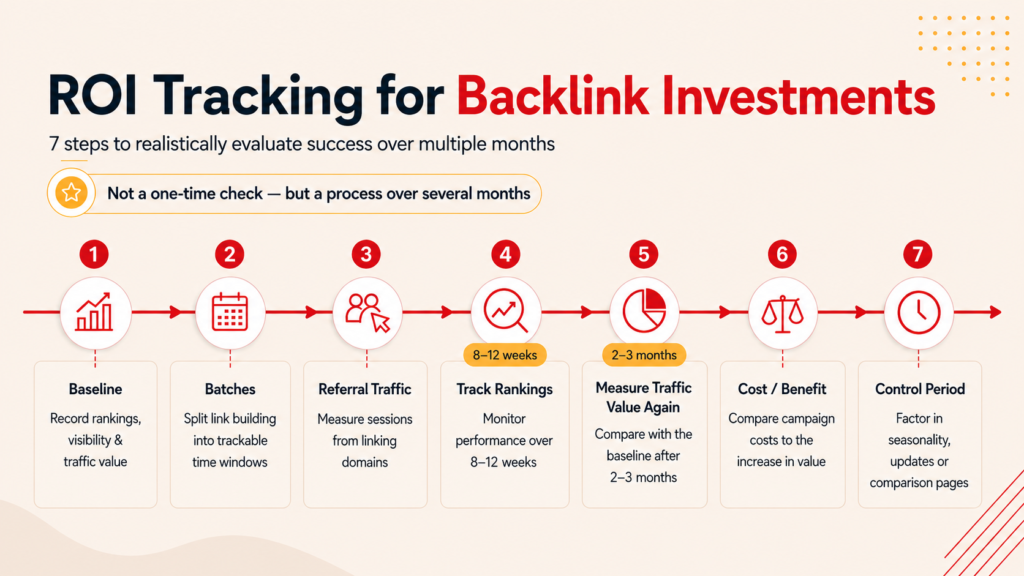
Unlike Google Ads, you can’t track the success of a single backlink down to the last euro. SEO impact unfolds over weeks and usually through the interplay of multiple links at once. Sounds complicated, but with the right routine, it’s quick to handle: these seven steps are enough to gauge the ROI of your backlink investment well enough to make informed buying decisions:
1. Establish a baseline before you buy
Note down the rankings, visibility, and Traffic Value of your target page(s) for the relevant keywords, using tools like Ahrefs or the Google Search Console performance report. Without a reference point, you won’t be able to prove any effect later.
2. Buy in fixed, recurring windows, not randomly
Plan your ongoing link building in clearly defined batches, for example 3 to 5 links a month, instead of buying links whenever you happen to feel the need. Each batch then becomes its own cleanly measurable unit: you’ll know exactly which links went live when, and can later attribute ranking and traffic changes to them specifically.
3. Measure referral traffic directly
This is the only part you can genuinely attribute to a single link: check the GA4 traffic acquisition report for sessions from the specific linking domain.
4. Track rankings over 8-12 weeks, don’t judge too soon
Indexing and trust-building take time. A tool like Ahrefs, Sistrix, or Search Console shows you how your target keywords develop over that period.
5. Re-measure the Traffic Value of your target page after 2-3 months and compare it to your baseline
The difference roughly equals what that additional organic traffic would have cost you via ads. This is where the Traffic Value concept genuinely applies, because this time it’s measured against your own page instead of the linking one.
6. Weigh campaign costs against the Traffic Value increase
This is what gives you the actual ROI. Weigh the cost of each link batch against the measured Traffic Value increase on your own target page from step 5. If a batch costs, say, €800, and your target page’s Traffic Value rises by €1,500 over the same period, the investment generally paid off. What matters here is always comparing against the value increase on your own site, not metrics from the linking domain.
7. Account for a control period
Seasonal fluctuations or Google updates can fake or mask effects. Where possible, compare against the same period last year, or against pages you didn’t buy any new links for during the same timeframe.
How to Buy Backlinks Safely: Step by Step
1. Define your target URL and anchor texts upfront
Plan a natural mix of branded, URL, and keyword anchor texts from the start.
2. Choose a provider with transparent, visible metrics
You should be able to see Domain Rating, traffic, and niche before buying.
3. Get backlinks approved before publication, so placement and context fit.
4. Keep your anchor text mix natural.
Details on the ideal mix below.
5. Build steadily instead of in spikes
Even growth looks more natural.
6. Track results continuously
Keep an eye on rankings, traffic, and indexing status.
Many people underestimate one point here, one even experienced buyers tend to overlook: the link’s lifespan. A backlink doesn’t reach its full effect immediately, it gains trust over time. The longer a link stays online and stable, the stronger we estimate its effect on your ranking to be.
Always clarify before buying how long the link is guaranteed to stay live, and avoid offers with no lifespan guarantee at all. We recommend at least 12 months as a benchmark. That’s exactly why we set our own link guarantee at Blogtec to 12 months as well: if a backlink disappears within that period, you automatically get a replacement, with no need to negotiate it yourself.
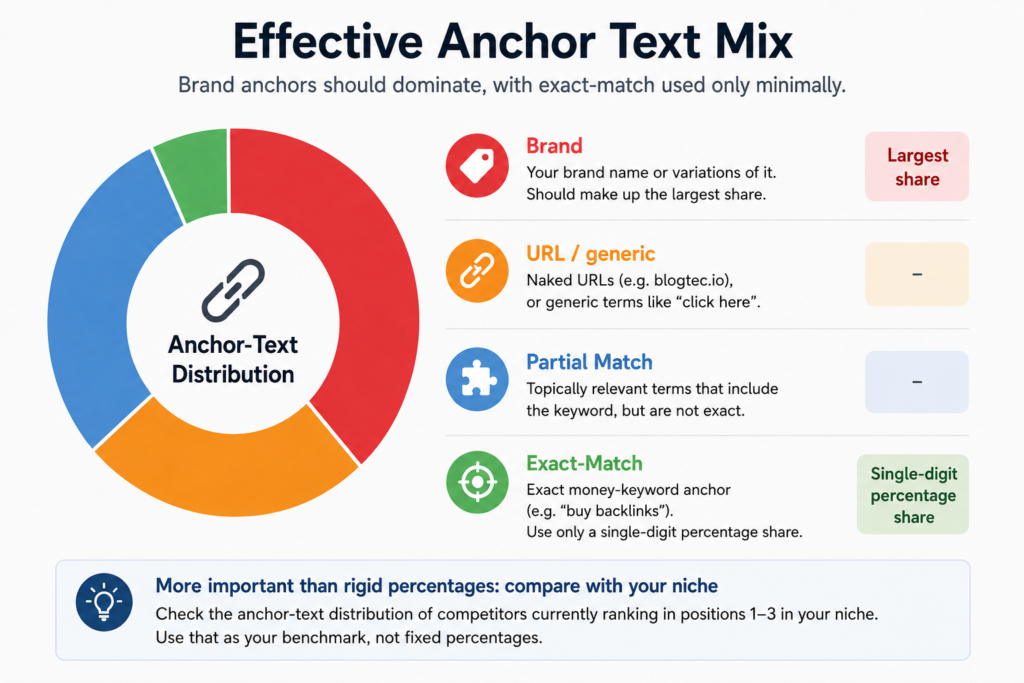
Bonus: What a Healthy Anchor Text Mix Looks Like
As a rough guideline, as described by Ahrefs among others: branded terms (e.g., “Blogtec”) should make up the largest share of your anchor text mix, supplemented by bare URLs, generic phrases like “click here,” and topically relevant partial-match anchors. Exact-match money-keyword anchors like “buy backlinks,” on the other hand, should only make up a low single-digit percentage. A rule of thumb that holds up in practice: comparing against your own niche matters more than rigid benchmarks. Check the anchor text distribution of the competitors currently ranking in positions 1-3.
Common Mistakes When Buying Backlinks
- PBNs and expired domains
Many SEO experts view private blog networks built from expired domains critically, the penalty risk is real. We generally advise against them.
- Link farms and mass links from freelance platforms cause more harm than good
- Exact-match anchor over-optimization is one of the easiest spam signals to detect
- Footer or sidebar links alone bring barely any clicks, and Google rates them lower
- Skipping a quality check before buying wastes budget in many cases with no measurable effect
- Pointing backlinks exclusively at money pages
If all your bought links point only to category or product pages, it quickly looks unnatural. Spread links across guide and content pages too. This creates a much more credible profile and simultaneously strengthens the pages that attract organic traffic through informational searches. - Not disavowing or removing harmful links
A backlink profile isn’t a “build it once and you’re done” project. Check it regularly for toxic or spammy links and disavow them through Google’s official Search Console Disavow Tool. New high-quality links won’t help much if toxic legacy links are weighing down your profile in the background.
Is Buying Backlinks Worth It in 2026?
Yes, but only if you do it right.
Buying backlinks technically isn’t compliant with Google’s guidelines, but in practice it’s a widespread and effective strategy, as long as you focus on topical relevance, real traffic, and editorial placement instead of the cheapest price per link.
The data is clear: a strong backlink profile clearly correlates with better rankings and more organic traffic, provided your technical SEO, structure, and content are already in good shape.
If you want to buy backlinks in a targeted, safe way, check out our backlink marketplace in the Link Center or take a look at our pricing and packages, with transparent metrics and at least a 12-month link guarantee.
Frequently Asked Questions About Buying Backlinks
Yes, no law prohibits buying backlinks. You do violate Google’s spam policies, though, if you present the links unmarked as an organic recommendation.
Mainly through unnatural patterns: sudden link spikes, link networks, exact-match money-keyword anchors, and links from topically irrelevant mass providers.
At Blogtec, prices start at €99 for forum links, €199 for press releases, €279 for business directories, and €100 for individual guest posts (premium ones cost €300 to €400 depending on the niche). Monthly packages start at €349.
That depends on the competition in your niche. As a rough guide, highly competitive commercial terms like “buy backlinks” typically require dozens of referring domains to reach the top 10, according to Ahrefs data.
You can combine both. Through our Link Center, you buy individual links yourself, with full control over selection and anchor text. With our monthly backlink packages, we take on the full strategic process for you as an agency, including planning and reporting.
Indexing usually takes a few days to weeks. Ranking effects typically show up after several weeks to months, depending on competition and your domain’s starting position.
A “bad neighborhood” is the unwanted association of your website with disreputable, spammy, or hacked sites, for example through links from private blog networks. Avoid providers who won’t let you see the neighborhood of a link source, and always check before buying how the linking page itself links out.
Disavowing means telling Google, through the Search Console Disavow Tool, that it shouldn’t count certain incoming links as a trust signal, for example because they come from toxic or spammy domains you have no control over.
No. A link profile that points exclusively to category or product pages quickly looks unnatural. Deliberately spread bought links across guide and content pages too. That creates a more credible profile and simultaneously strengthens the content that attracts informational-intent traffic.