
Anyone who wants to succeed with SEO cannot avoid one topic: backlinks. They have been among the most important ranking factors for years and help search engines assess the trustworthiness and relevance of a website. But before you can build new links or evaluate existing ones, you first need to find a suitable backlink.
This is where the main challenge lies. The internet is vast, potential link sources are often hidden in unexpected places and not every link actually benefits your website. However, by taking a systematic approach, you can quickly identify high-quality sources, discover valuable links and significantly improve your off-page strategy.
Here, you will learn how to find a relevant backlink, which methods are particularly effective and how to analyse existing links correctly.
The Key Points at a Glance
- If you want to find high-quality backlinks, you should analyse competitors, industry portals and existing mentions.
- Not every link is valuable. Quality beats quantity.
- Backlink tools help you discover new link sources and identify risks early.
- Regular analyses show which links support rankings and which are more of a burden.
- Clean link building is based on relevance, trust and natural linking.
Finding Backlinks – The Treasure Hunt Begins
Trying to find a good backlink is a little like searching for gold. Of course, you can dig at random. Statistically speaking, however, you are more likely to succeed where others have already struck gold.
Analyse Competitors and Discover Opportunities
The easiest way to find a new backlink often leads through your competitors. After all, many of them already rank for keywords that are also relevant to your business.
SEO tools such as Ahrefs, Semrush and Majestic show you which websites link to your competitors. This often reveals exciting opportunities:
- Industry directories
- Specialist portals
- Blogs
- Magazines
- Partner pages
- Resource lists
If several competitors have received a link from the same website, it is worth taking a closer look. It is often a potential link source that could also be relevant to you.
Identify Unlinked Brand Mentions
Sometimes, you can find a valuable backlink without actively carrying out any link building at all.
Many businesses are already mentioned online but do not receive a link. Blogs, magazines or specialist portals mention the brand but do not link to its website.
This is where the potential lies.
With the help of Google Alerts or professional SEO tools, you can identify these mentions and contact the website operators politely. A brief request is often all it takes to turn a simple mention into a genuine backlink.
Use Industry Directories That Offer Genuine Value
Not every directory is automatically poor quality. Quite the opposite. Anyone looking to find a relevant backlink should review high-quality industry directories. Platforms are particularly worthwhile if they have:
- their own visibility on Google
- editorial review processes
- a clear topical focus
- genuine user traffic
The focus should always be on quality. Ten strong directory listings are often far more valuable than a hundred entries in dubious link graveyards.
Research Guest Posts and Specialist Articles
Another way to find a high-quality backlink is to research guest posting opportunities.
Many blogs and specialist portals publish credible contributions from experts. If you provide helpful content, you will often have the opportunity to link to yourself or your business.
Particularly promising options include:
- industry blogs
- trade publications
- expert platforms
- association websites
- company blogs
The advantage is that you gain not only a backlink, but often additional reach and brand awareness as well.
Identify Resource Pages and Link Lists
Many websites maintain resource pages or content hubs. These bring together useful tools, studies, guides or providers.
By searching specifically for terms such as:
- resources
- recommendations
- useful links
- tools
- partners
you can often find a suitable backlink surprisingly quickly.
These pages frequently offer high-quality links with strong topical relevance, particularly for specialised B2B subjects.
Find Backlinks Faster With Link Finder AI
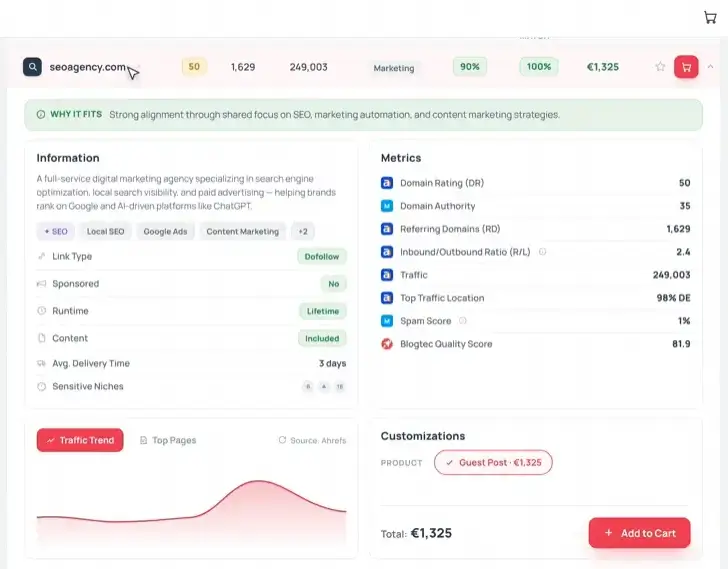
If you don’t want to research every potential link source manually, you can use specialised tools. Link Finder AI in Blogtec’s Link Center helps you identify suitable websites for link building and filter them directly based on relevant criteria.
After entering your own domain, the tool analyses potential link sources and evaluates them based on metrics such as:
- Domain Rating (DR),
- Referring Domains (RD),
- organic traffic, and
- topical relevance.
You also receive an assessment of why a website is a good fit for your project and how strong the topical match is.
Especially practical: instead of manually checking individual pages, you can compare potential candidates directly, filter them by category and find a suitable backlink much faster. This saves valuable time in research and prioritisation, especially for agencies, companies and SEO managers.
Not Every Backlink Is a Direct Hit

Finding any backlink at all is one thing. Finding a good backlink is another.
In the past, the general rule was often: the more links, the better. Today, Google evaluates them far more carefully.
Ideally, a backlink that is valuable to you should have the following characteristics:
| Characteristic | Why It Matters |
| Topical Relevance | The linking page is relevant to your subject |
| Trust | The domain has authority and credibility |
| Organic Traffic | The website receives genuine visitors |
| Editorial Context | The link is meaningfully integrated into the content |
| Naturalness | The link does not appear to have been bought or manipulated |
Accordingly, a link from a small specialist website that is relevant within its particular field can often be far more valuable than a link from a huge website with no topical connection.
How to Check Your Backlinks
If you want to find new backlinks regularly, you should also monitor your existing link profile. After all, not every existing link remains useful indefinitely.
Monitor the Most Important Metrics
If you want to check a backlink, you should analyse several factors:
- Linking domain
- Domain Authority or Domain Rating
- Organic traffic
- Anchor text
- Link destination
- Follow or nofollow status
- Topical relevance
Combining these metrics provides a much clearer picture than looking at individual figures alone.
Identify Harmful Links Early
Not every link benefits your website. Some can even become problematic. If you want to check a backlink, pay particular attention to:
- obvious link networks
- spam websites
- irrelevant directories
- automatically generated pages
- domains with questionable content
A regular audit helps you identify potential risks early. This does not mean that every weak link must be removed immediately. Nevertheless, you should know which websites link to your site.
Identify Lost Backlinks
Sometimes, a link simply disappears. Without saying goodbye. Perhaps an article was deleted, a page was revised or a website relaunch took place. That is why it is worth monitoring your link structure regularly.
If you identify lost links, you can often contact the website owner and recover the backlink. This effort can quickly pay off, particularly when strong domains are involved.
Check the Ratio of Incoming to Outgoing Links
An often underestimated factor in backlink analysis is the ratio between a website’s incoming and outgoing links.
If you want to find a potential backlink, it is worth looking at the number of outgoing links. If a page links to hundreds of other domains, each individual link usually carries less value.
Additional metrics, such as organic traffic or a domain’s top-ranking keywords, can help you assess its quality more accurately. This allows you to recognise more quickly whether a website has genuine visibility or merely appears to be a strong link source.
Strong Backlinks Are Part of a Good Off-Page Strategy
Finding a strong backlink is not a game of chance, but the result of a well-planned off-page strategy. By analysing competitors, identifying relevant link sources and regularly reviewing the quality of existing links, you create the foundation for sustainable rankings and greater organic visibility.
At the same time, not every link is a good link. Relevance, trust and a natural link profile are what matter. That is precisely why it is worth investing time in research, analysis and monitoring.
If you need support with building high-quality links or developing a comprehensive off-page strategy, Blogtec can assist you with data-driven SEO expertise, a professional backlink marketplace and transparent processes. This turns individual backlinks into a sustainable strategy that improves your visibility over the long term.
FAQ
New backlinks can increase your visibility, attract additional visitors and send positive ranking signals to search engines. That is why it is worth continuously analysing potential link sources.
A good backlink comes from a trustworthy website, is topically relevant, appears naturally within editorial content and ideally originates from a domain with organic traffic.
For most websites, a monthly audit is recommended. In highly competitive industries or when actively building links, weekly checks may also be worthwhile.
No. Quality is far more important than sheer quantity. A small number of strong, relevant links often achieves better results than a large number of weak ones.